- Sound design
- Architecture
- Oscillators
- Algorithms
- Low Frequency Oscillators (LFOs)
- Envelope generators
- Filters
- Amplitude modulation
- Pitch modulation
- Panning & EQ
- Dynamics, Sidechaining, Gating, Ducking, Compression and Transient Shaping
- Distortion, Saturation, Bit-crushing
- Global Send Multi-effects
- DJ FX
- Wavetable Synthesis
- A word about authenticity
- Sound design
- Distortion, Saturation, Bit-crushing
Distortion, Saturation, Bit-crushing
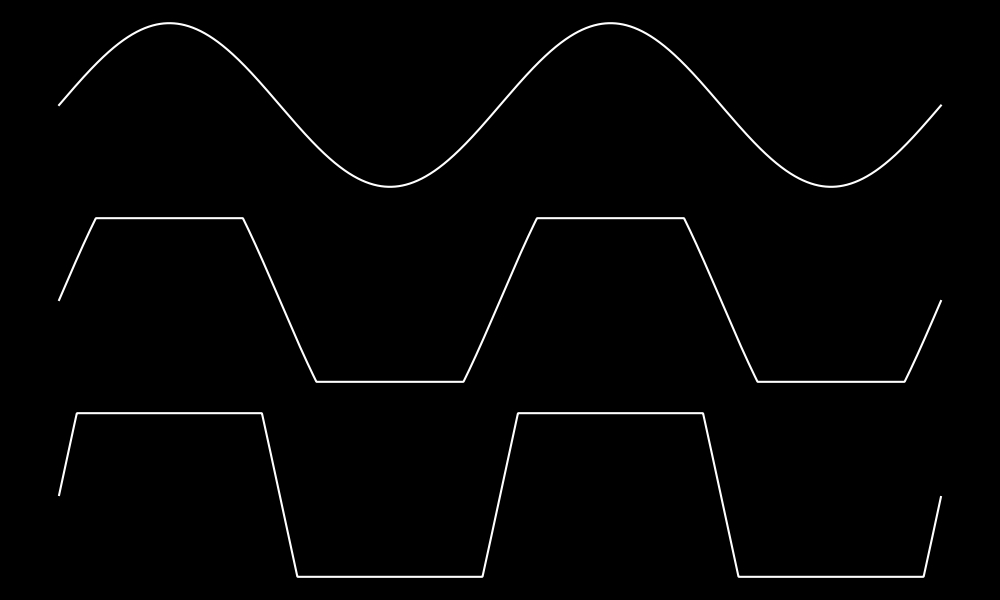
Each track has its own configurable distortion (choice of clipping or folding distortion), saturation and bit-crushing effects.
Distortion
Two types of distortion are available; clip distortion and wave folding distortion.
Clipping can make sounds more aggressive or "gritty", which is useful in creating distorted guitar sounds or punchy basslines.
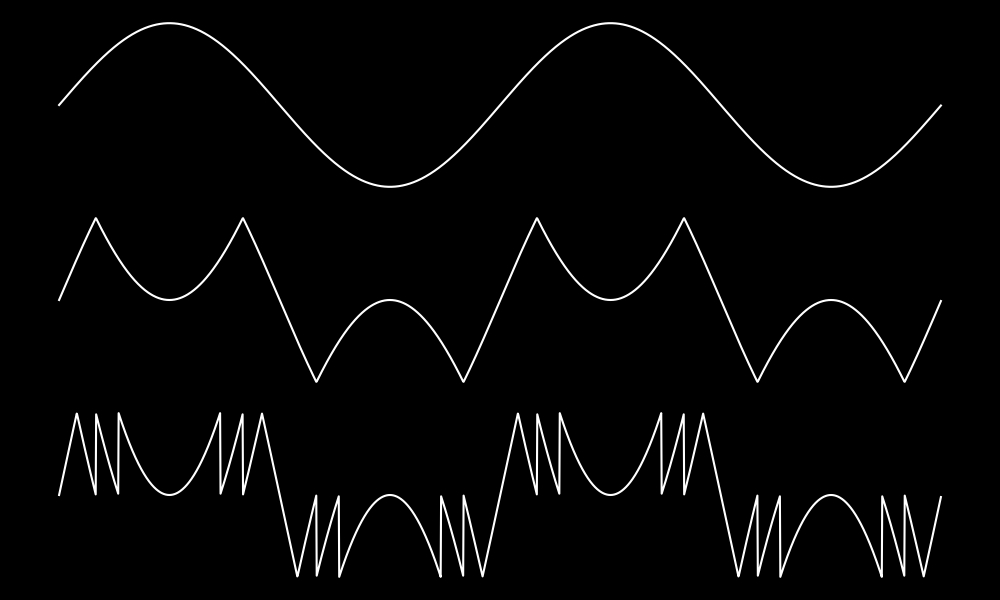
Fold-back distortion can produce unusual and unpredictable harmonics, which can be great for creating unique textures in electronic music or adding depth to synthetic sounds.
These distortions modify the harmonic content of the original audio, often making it richer, more complex, and suitable for various artistic or aesthetic purposes in music production and sound design.
- Positive amounts for the 'dist' parameter on a track's 'GLob' page under 12/A4, specify a traditional clipping distortion; the signal is multiplied by 2^value ("two to the power of the value") and any signal above a threshold is truncated to that threshold. These values are indicated by a 'CL' prefix.
- Negative amounts for the 'dist' parameter on a track's 'GLob' page under 12/A4,specify a fold back distortion; the signal is multiplied by 2^value ("two to the power of the value") and any signal above a threshold is folded back in a specific way to below the threshold. These values are indicated by a 'Fo' prefix.
Saturation
Saturation (11/A3/'Satu' on a track's GLob page) emulates the way vacuum tubes behave as a signal approaches the clipping limit. Rather than clipping, the signal "bunches up" against the clipping limited, rather than being unceremoniously cut off. It gives a warm, analog tone to the signal.
Saturation is an integral part of of how analog filters behave, and is especially important for virtual analog patches.
Bit-crushing
Not to be confused with sample rate reduction, bit-crushing (10/A2/bt.Cr on a track's Glob page) is the act of reducing dynamic range bit-depth. It creates stepping in a waveform, and can create a hiss in the lower volume parts of a patch. You can choose to enact bit-crushing before or after the filter. Doing it before the filter can help emulate early digital synths (or samplers) that used low-bit depth samples, but still had analog filters. Doing it after the filter can help emulate early drum computers where the filter was part of the "baked" sample, and the resulting sample was low bit-depth and send straight to a DAC.
If you are looking for sample rate reduction, look at the Spectral Quality (5/Ki/QLty on a track's GLob page) setting, or the sample hold (16/A8/SM.Ho) on the Osc1/Osc2 pages).
You may also be interested in...
- Synthesizer | Sequencer | Sampler | Mastering
- Scenes (under Live mode)
Hold Write and press all the 1/Cd through 16/A8 tracks you wish to sound when the scene is active.
- Song Mode (under Cheat sheet)
Use Fragment (mutes/unmutes/solos) in Sequencer / Track Edit mode.
- Tracks (under Full documentation, guide and tutorial)
"A3" / "all-purpose/auxiliary 3"; anything extra you might need in your song.
- Arranging techniques and tips (under Fragments; arranging and building your song)
The Woovebox' powerful conditional triggering already tends to make sure that changes take place regularly.
- Sound design
- Architecture
- Oscillators
- Algorithms
- Low Frequency Oscillators (LFOs)
- Envelope generators
- Filters
- Amplitude modulation
- Pitch modulation
- Panning & EQ
- Dynamics, Sidechaining, Gating, Ducking, Compression and Transient Shaping
- Distortion, Saturation, Bit-crushing
- Global Send Multi-effects
- DJ FX
- Wavetable Synthesis
- A word about authenticity