- Sound design
- Architecture
- Oscillators
- Algorithms
- Low Frequency Oscillators (LFOs)
- Envelope generators
- Filters
- Amplitude modulation
- Pitch modulation
- Panning & EQ
- Dynamics, Sidechaining, Gating, Ducking, Compression and Transient Shaping
- Distortion, Saturation, Bit-crushing
- Global Send Multi-effects
- DJ FX
- Wavetable Synthesis
- A word about authenticity
Reverb
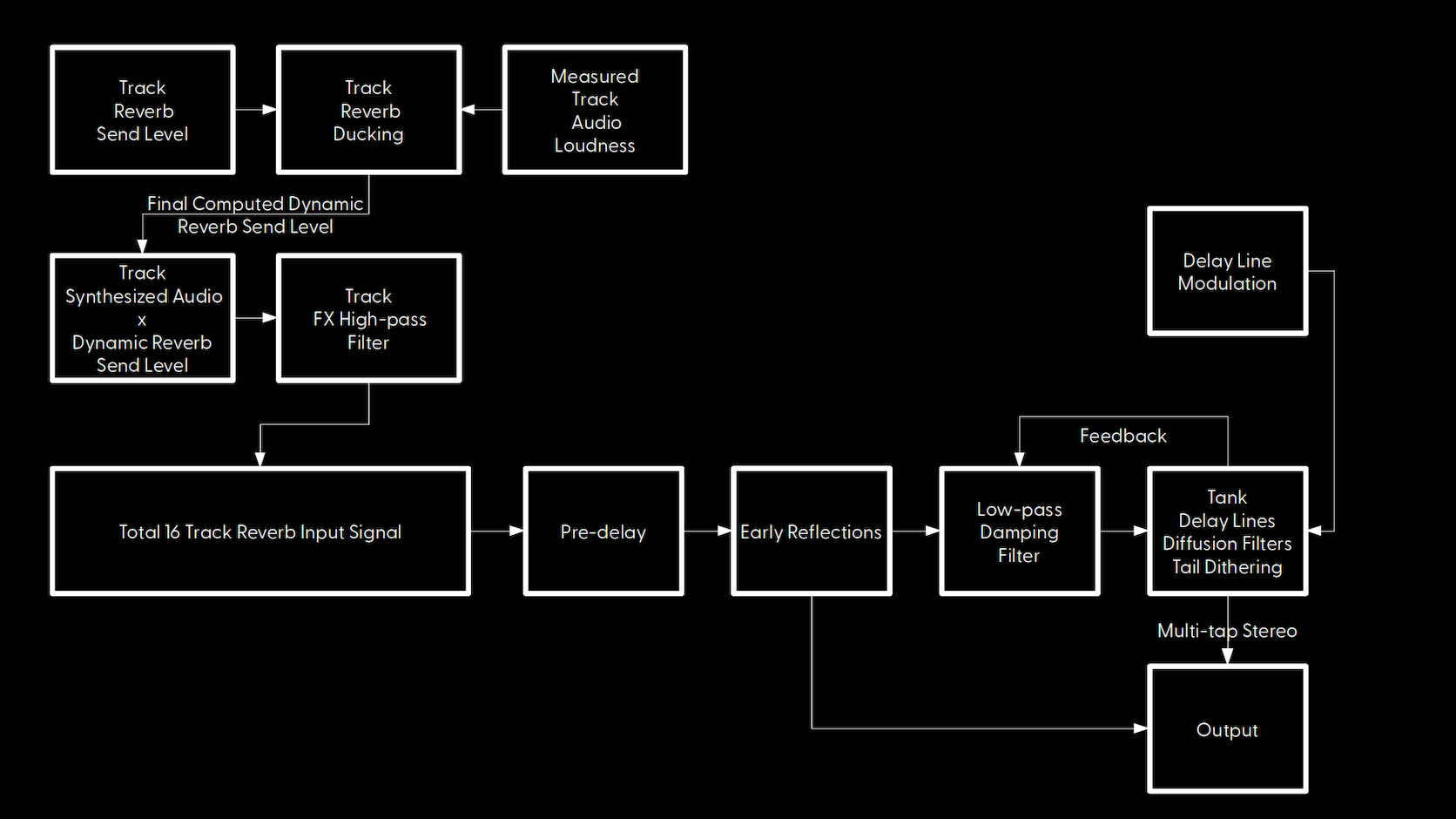
Your Woovebox comes with a versatile, high quality reverb effect, with special attention to fitting well in a finished mix.
It provides a lush sound with controllable feedback, pre-delay, damping and modulation ("haze"), plus early reflection simulation and tail noise shaping, without metallic artifacts or obvious repeats in tails.
In this reverb design, feedback (13/A5/rv.Fb) primarily controls how large the space is that is being simulated from 0 (tiny) to 127 (huge).
Damping (14/A6/rv.dM) controls how full or empty the space is with absorbers (for example carpet, curtains). It simulates how real rooms and spaces "eat" high frequencies. A "pass" value will not absorb any high frequencies and sound almost shimmery and ethereal. Settings other than "pass", show the frequency above which high frequencies are attenuated ("absorbed").
Pre-delay (15/A7/rv.P.d) ensures a sound sent to the reverb has some time (specified in milliseconds) to play its attack transient before its reverb counterpart kicks in. This allows sounds to punch through in the mix before they - potentially - get lost in their own reverb.
Finally, modulation (16/A8/rv.Md) specifies an optional modulation/turbulence depth for the delay lines to simulate atmospheric phenomenon such as air temperature, humidity and moving air. Higher value can convey the (imaginary) sound and shimmer of "heat haze".
Local and global reverb ducking
Per-track, the final reverb send level for the track may be dynamically reduced/"ducked" (14/A6/rv.dU on a track's dyna page) based on the track's output volume. This ensures a sound playing on a track is not drowned out by its own reverb. Its reverb tail only becomes progressively audible once the track itself stops playing a sound.
Per-track, the total global reverb signal may also be influenced in the same manner by a global ducking setting (13/A5/Gb.du on a track's dyna page). This is useful if you need to make sure a track's sound is not lost/drowned out by the effects (such as reverb). Note that this setting also affects delay 1. For example, this is useful when you need to make sure a kick is audible when an - otherwise - overwhelming reverb is sounding at the same time.
Both local and global ducking use the per-track compessor's attack (11/A3/CM.At on a track's dyna page) and release (12/A4/CM.rL on a track's dyna page) times.
High-pass filter before send FX
To avoid low frequency build-up ("mud") in the reverb tail, you can use the high-pass filter under 7/hh/EF.HP on the Pan & EQ ("PnEq") page. This setting filters low frequencies out a track's audio, before sending it to the reverb and delay effects.
You may also be interested in...
- "Knight Rider" (1982) (remake) song SYX (under Download 3.0 example songs and patches .SYX)
The secondary delay unit is configured to use its "sparkle" algorithm to selectively aid high frequency sizzle on some patches.
- 8. Pt.rS Playthrough Counter Reset Behavior (under Patterns)
'Awys ' (always); playthrough counters are always reset when this pattern number is encountered, including as part of a pattern chain.
- Tracks (under The very basics)
"A6" / "all-purpose/auxiliary 6"; anything extra you might need in your song.
- Pages (under Tracks)
The "left-most" page is always the Sequencer ("Seq") page, where you can edit the steps of the currently selected pattern.
- DSP usage and warnings (under Understanding DSP load)
This temporary overlap of playing voices will cause the DSP to work extra hard.
- Sound design
- Architecture
- Oscillators
- Algorithms
- Low Frequency Oscillators (LFOs)
- Envelope generators
- Filters
- Amplitude modulation
- Pitch modulation
- Panning & EQ
- Dynamics, Sidechaining, Gating, Ducking, Compression and Transient Shaping
- Distortion, Saturation, Bit-crushing
- Global Send Multi-effects
- DJ FX
- Wavetable Synthesis
- A word about authenticity